Suppose the shreds of our prayers and of our faiths could themselves become a radical new form of devotion. Bruce Beasley confronts the apocalyptic zeitgeist of our time (political turmoil, societal division and isolation, spiritual despair, environmental catastrophe) and the crisis of faith in the human future. These poems make of the vocabulary of doubt a strange kind of sermon, summoning into chorus Heraclitus, Zeno, the Buddha, Roget’s Thesaurus, ancient prayers and hymns and scriptures, and an AI chatbot. In these fractured and ecstatic psalms, Beasley makes his ruptured way toward a faith that relies not on dogmas and creeds, but on a broken utterance for a torn and living faith.
Praise
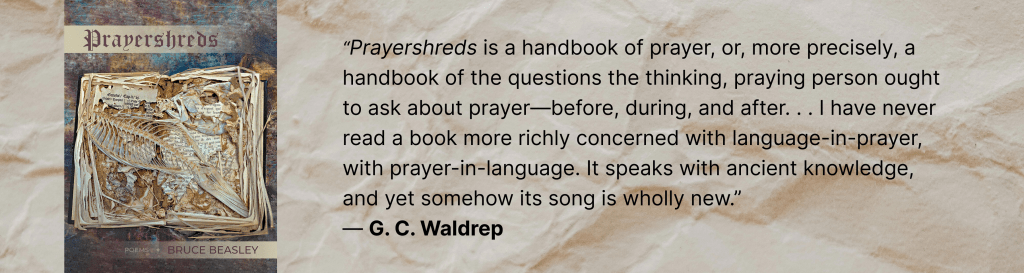
“In Prayershreds,Bruce Beasley approaches prayer with a postmodern sensibility, but without irony—a rare combination. Or the irony is disarmed in wonder, a wide-eyed wonder equally accustomed to postures of terror and pleasure, of ecstasy and dismay. Prayershreds is a handbook of prayer, or, more precisely, a handbook of the questions the thinking, praying person ought to ask about prayer—before, during, and after. These are actionable questions, parts of an unperceivable whole because they are phrased in language: ‘language being / a torn hymnal, a ripped sheet.’ I have never read a book more richly concerned with language-in-prayer, with prayer-in-language. It speaks with ancient knowledge, and yet somehow its song is wholly new.” — G. C. Waldrep
“As a fan of Bruce Beasley’s earlier work, I am glad to see this volume of new verse in which he makes an even deeper dive into the nature of language. Like E. E. Cummings and James Joyce, Beasley is a poet of language, someone who loves words so deeply he can’t resist wrestling with them, sometimes syllable by syllable. Admitting that he often wanders ‘off-trail, far into words,’ he makes us see anew the language we use every day and too often take for granted.” — Kathleen Norris
“The intellectually prodigious poet Bruce Beasley is uncannily wired to perceive, fracture, and reshape the sonic cosmos of language, particularly the language of prayer (praise, thanksgiving, petition), with an acuity that is both feverish and reverent. One thinks of Hopkins on psilocybin, the Psalmist translating the Dhammapada. Our iconoclastic guide through this antic, homophone-driven, thesaural minefield of the discourse of belief and unbelief is as conversant with AI chatbots as with the Biblical gospels, and though our narrator despairs at times, he writes, ‘I doubt You Lord but only / the way I doubt / myself a Thinking Thing.’ And to the reader, child of God, this blessing: ‘Bewell, / bewell, dwell / a brief while here, anonymous / and casual visitor, Antonym, implacably resistant to all name.’” — Lisa Russ Spaar
“Bruce Beasley’s ninth collection of poems released this year, Prayershreds. A journey through a landscape of beautiful ruins—perhaps the current state of human language—with the poet-agent turning over bits and sounds to ask what meaning in the linguistic fossil record might still sing or shine true. The book begins with a study of self-portrait, ‘I am words in a language I don’t speak / a dead one’, and ends in a study of faith: ‘a faith, a little one. Which chooses / to last by rooting itself among Coke can and gulf feathers …’ The cry from the depths in the poems, in the entire book as an ars poetica, is a cry from between the torn and broken aspects essential to human language: between sound, intended meaning, and written sign, we are all maybe always potentially lost as meaning shifts, repeats, dissipates: so, what to say of prayer—or poetry, for that matter? Many thanks to Orison Books for giving me the opportunity to read Beasley’s latest remarkable work.” — Gina Franco, Knox College

 Bruce Beasley